PathMap
☰
Curation Policy
FAQ
About
Contact
Legal
GitHub
PathMap Literature Based Discovery Engine
Share your Discovery:
Guaranteed to find unpublished literature based discoveries.
Clear Search
Experiment #00000143
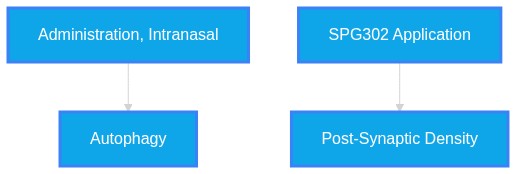
Hypothesis: Dual-axis intranasal delivery of Spermidine-Modified Ginger-Derived Extracellular Vesicles (Spd-GDEVs) and SPG302 (Tazbentetol) via the cribriform plate may synergistically reverse motor neuron degeneration in sporadic ALS by simultaneously activating upstream proteostatic clearance networks and restoring downstream cytoarchitectural synaptic timing.
Administration, Intranasal
_gates_from_administration__intranasal
Autophagy
_gates_to_autophagy
SPG302 Application
_gates_from_spg302_application
Post-Synaptic Density
_gates_to_post_synaptic_density
View Results
Experiment #00000139
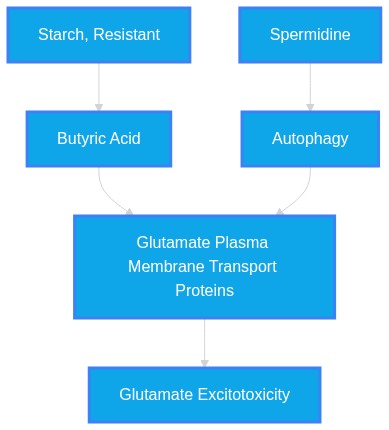
Foundational Dietary Theory: The dietary synergy between Hi-Maize and 6x Spermidine Yeast creates a potential cellular supply-and-clearance loop within the brain's astrocytes. Circulating spermidine metabolites utilize documented astrocytic polyamine uptake systems to access the central nervous system. Once inside, this exogenous spermidine drives FAM134B-mediated ER-phagy, clearing the endoplasmic reticulum matrix. This clearance removes the ER-stress bottleneck, allowing newly transcribed astrocytic EAAT2—upregulated by gut-derived butyrate from Hi-Maize fermentation—to successfully traffic to the plasma membrane and mitigate synaptic glutamate excitotoxicity.
Starch, Resistant
_gates_from_starch__resistant
Butyric Acid
_gates_to_butyric_acid
_gates_from_butyric_acid
Glutamate Plasma Membrane Transport Proteins
_gates_to_glutamate_plasma_membrane_transport_proteins
Spermidine
_gates_from_spermidine
Autophagy
_gates_to_autophagy
_gates_from_autophagy
_gates_from_glutamate_plasma_membrane_transport_proteins
Glutamate Excitotoxicity
_gates_to_glutamate_excitotoxicity
+5 more
View Results
Experiment #00000138
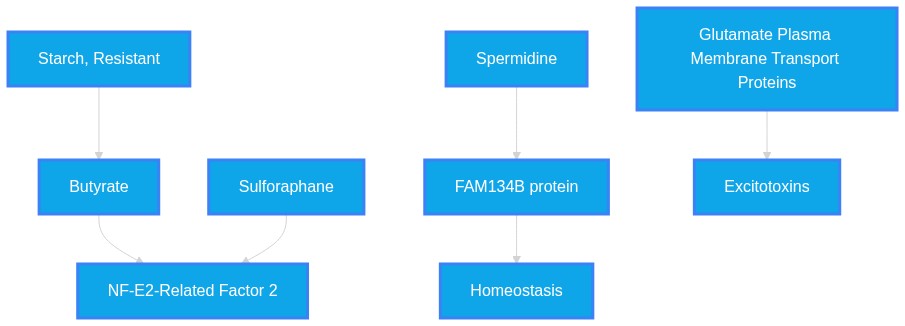
Dietary butyrate from resistant starch may synergize with sulforaphane-driven Nrf2 activation and spermidine-mediated FAM134B ER-phagy in order to restore astrocytic EAAT2 membrane trafficking and potentially clear synaptic glutamate excitotoxicity in neurodegeneration. (Literature Based Discovery)
Starch, Resistant
_gates_from_starch__resistant
Butyrate
_gates_to_butyrate
_gates_from_butyrate
NF-E2-Related Factor 2
_gates_to_nf_e2_related_factor_2
Sulforaphane
_gates_from_sulforaphane
Spermidine
_gates_from_spermidine
FAM134B protein
_gates_to_fam134b_protein
_gates_from_fam134b_protein
Homeostasis
_gates_to_homeostasis
Glutamate Plasma Membrane Transport Proteins
_gates_from_glutamate_plasma_membrane_transport_proteins
Excitotoxins
_gates_to_excitotoxins
+10 more
View Results
Experiment #00000128
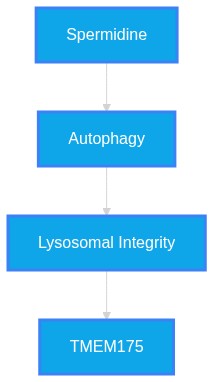
Discovered Hypothesis: Spermidine-mediated autophagic activation may serve as an upstream regulator of lysosomal TMEM175 activity to prevent proteinopathy in C9orf72-ALS/FTD models.
Spermidine
_gates_from_spermidine
Autophagy
_gates_to_autophagy
_gates_from_autophagy
Lysosomal Integrity
_gates_to_lysosomal_integrity
_gates_from_lysosomal_integrity
TMEM175
_gates_to_tmem175
View Results
Experiment #00000126
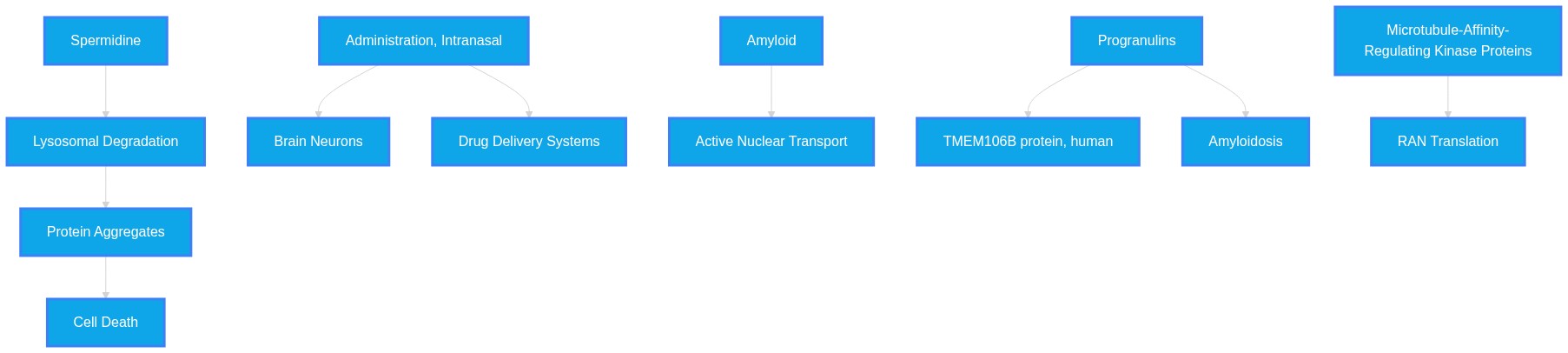
Hypothesis: Intranasal delivery of Spermidine-modified Ginseng Extracellular Vesicles (S-GEVs) loaded with multi-targeted mRNA suppresses MARK2-eIF2α-driven RAN translation to prevent dipeptide repeat clogging of FG-nucleoporins, synergizing with progranulin-mediated lysosomal clearance to arrest TMEM106B amyloid accumulation and block the execution of p38-Lamin B1-dependent Karyoptosis in motor neurons.
Spermidine
_gates_from_spermidine
Lysosomal Degradation
_gates_to_lysosomal_degradation
_gates_from_lysosomal_degradation
Protein Aggregates
_gates_to_protein_aggregates
_gates_from_protein_aggregates
Cell Death
_gates_to_cell_death
Administration, Intranasal
_gates_from_administration__intranasal
Brain Neurons
_gates_to_brain_neurons
Progranulins
_gates_from_progranulins
TMEM106B protein, human
_gates_to_tmem106b_protein__human
Amyloid
_gates_from_amyloid
Active Nuclear Transport
_gates_to_active_nuclear_transport
Drug Delivery Systems
_gates_to_drug_delivery_systems
Microtubule-Affinity-Regulating Kinase Proteins
_gates_from_microtubule_affinity_regulating_kinase_proteins
RAN Translation
_gates_to_ran_translation
Amyloidosis
_gates_to_amyloidosis
+20 more
View Results
Experiment #00000125
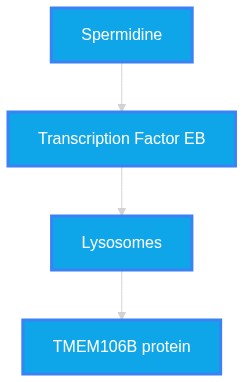
Discovery: Considering PubMed #37563705, #42012729, and #42541426, Spermidine is a known inducer of autophagy through EP300 inhibition and TFEB activation. Since TMEM106B amylofilaments induce lysosomal dysfunction, TFEB-driven restoration of lysosomal capacity would logically prevent the accumulation of these filaments.
Spermidine
_gates_from_spermidine
Transcription Factor EB
_gates_to_transcription_factor_eb
_gates_from_transcription_factor_eb
Lysosomes
_gates_to_lysosomes
_gates_from_lysosomes
TMEM106B protein
_gates_to_tmem106b_protein
View Results
Experiment #00000124
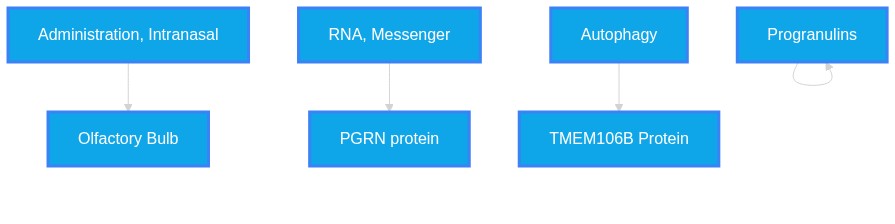
Hypothesis: Intranasal delivery of Spermidine-modified Ginseng Extracellular Vesicles (S-GEVs) loaded with GRN mRNA exploits the cribriform plate anatomy to bypass the blood-brain barrier, providing a neuro-targeted delivery system for progranulin gene therapy that acts synergistically with spermidine-induced autophagy to suppress pathological TMEM106B amyloid accumulation and restore endolysosomal homeostasis.
Administration, Intranasal
_gates_from_administration__intranasal
Olfactory Bulb
_gates_to_olfactory_bulb
Progranulins
_gates_from_progranulins
_gates_to_progranulins
RNA, Messenger
_gates_from_rna__messenger
PGRN protein
_gates_to_pgrn_protein
Autophagy
_gates_from_autophagy
TMEM106B Protein
_gates_to_tmem106b_protein
+5 more
View Results
Experiment #00000123
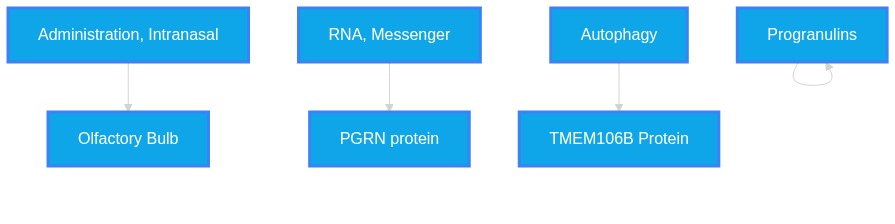
Hypothesis: Intranasal delivery of Spermidine-modified Ginseng Extracellular Vesicles (S-GEVs) loaded with GRN mRNA exploits the cribriform plate anatomy to bypass the blood-brain barrier, providing a neuro-targeted delivery system for progranulin gene therapy that acts synergistically with spermidine-induced autophagy to suppress pathological TMEM106B amyloid accumulation and restore endolysosomal homeostasis.
Administration, Intranasal
_gates_from_administration__intranasal
Olfactory Bulb
_gates_to_olfactory_bulb
Progranulins
_gates_from_progranulins
_gates_to_progranulins
RNA, Messenger
_gates_from_rna__messenger
PGRN protein
_gates_to_pgrn_protein
Autophagy
_gates_from_autophagy
TMEM106B Protein
_gates_to_tmem106b_protein
+5 more
View Results
Experiment #00000120
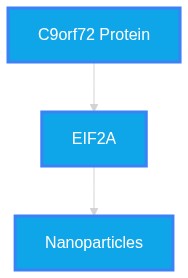
Discovery: Considering PubMed #41177462 and PubMed #41231952, Spermidine-modified extracellular vesicles can mitigate ALS-related C9orf72 RAN translation by modulating the MARK2-eIF2α stress-sensing axis.
C9orf72 Protein
_gates_from_c9orf72_protein
EIF2A
_gates_to_eif2a
_gates_from_eif2a
Nanoparticles
_gates_to_nanoparticles
View Results
Experiment #00000119
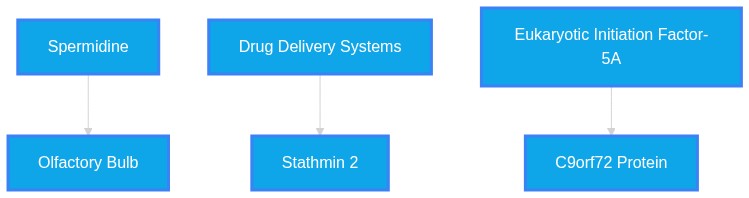
Hypothesis: Considering PubMed #41177462, Intranasally administered GDEVs, specifically spermidine-modified ginger extracellular vesicles, may offer a multi-target therapeutic strategy for C9orf72-associated ALS by crossing the blood-brain barrier via olfactory routes to potentially deliver gene-editing components, support axonal translation, restore STMN2 expression, and attenuate neuroinflammation.
Spermidine
_gates_from_spermidine
Olfactory Bulb
_gates_to_olfactory_bulb
Drug Delivery Systems
_gates_from_drug_delivery_systems
Stathmin 2
_gates_to_stathmin_2
Eukaryotic Initiation Factor-5A
_gates_from_eukaryotic_initiation_factor_5a
C9orf72 Protein
_gates_to_c9orf72_protein
+2 more
View Results
Reference Abstract
Loading...
Source: PubMed
View on PubMed